
-
+25M THB
Annual financial impact
-
-80%
Rework and lead times
-
+30%
Data accuracy
KRIS (research, innovation, and technology transfer unit of King Mongkut’s Institute of Technology, Ladkrabang, Thailand) faced a growing challenge: critical academic service processes were slow, information was fragmented, and teams spent excessive time correcting work instead of advancing projects. As the volume and complexity of research activities grew, these issues became harder to ignore — delays increased, rework became routine, and the overall workflow lost consistency.
To change this, KRIS partnered with Kaizen Institute Thailand to rethink how work moved across the entire academic service cycle. The goal was simple: make processes clearer, faster, and easier for everyone involved.
The transformation unfolded in two phases, each addressing different parts of the system. Together, they created a more stable, transparent, and efficient way of working and delivered measurable improvements in speed, accuracy, and financial performance.
Transforming academic research services at KMITL
King Mongkut’s Institute of Technology Ladkrabang (KMITL), through its KRIS division, embarked on a full‑scale operational transformation to address chronic delays, fragmented processes, data inaccuracy, and financial losses across its academic research services. Partnering with Kaizen Institute Thailand, KRIS implemented a multi‑phase Lean Transformation Program that delivered over 25 million THB in annualized financial impact, eliminated rework, standardized workflows, and established a sustainable performance management culture.
The program covered: Approval Process, Lean Project Management, Data Storage Management, IP Protection, Past Performance Score Improvement, Internal Productivity, and Ethics Approval Lead Time Reduction — creating an end‑to‑end operational excellence system for academic research services.
The challenge: fragmented processes slowing academic services
KRIS is responsible for managing academic service projects, research contracts, disbursements, IP submissions, and compliance processes for KMITL. Before the transformation, KRIS faced:
- Long approval lead times.
- High rework rates.
- Fragmented project management.
- Manual, decentralized data.
- Penalty fees due to project delays.
- Lack of visibility across the portfolio.
- Inefficient document flows.
- No standard operating procedures.
- Low data accuracy.
- High workload and redundant communication.
These issues resulted in opportunity losses of 21M THB, penalty fees, and significant operational waste.
The transformation approach
To address the operational challenges, KRIS and Kaizen Institute Thailand designed a transformation program structured in two phases. The first phase focused on stabilizing core operations and creating standardized workflows, while the second phase aimed to strengthen strategic capabilities and institutional performance.
Phase 1 – Stabilizing operations and creating process flow
The first phase focused on eliminating operational bottlenecks, standardizing key processes, and establishing a reliable data foundation for academic service management.
Three critical areas were addressed: approval processes, project management, and data management.
1. Approval process transformation — From fragmentation to flow
The approval workflow was one of the most critical pain points for KRIS. Before the transformation, approvals were slow, inconsistent, and heavily dependent on manual processes, leading to frequent rework and missed project deadlines.
Approval lead times regularly exceeded 15 days, and officers followed different working methods, creating significant variation and inefficiencies.
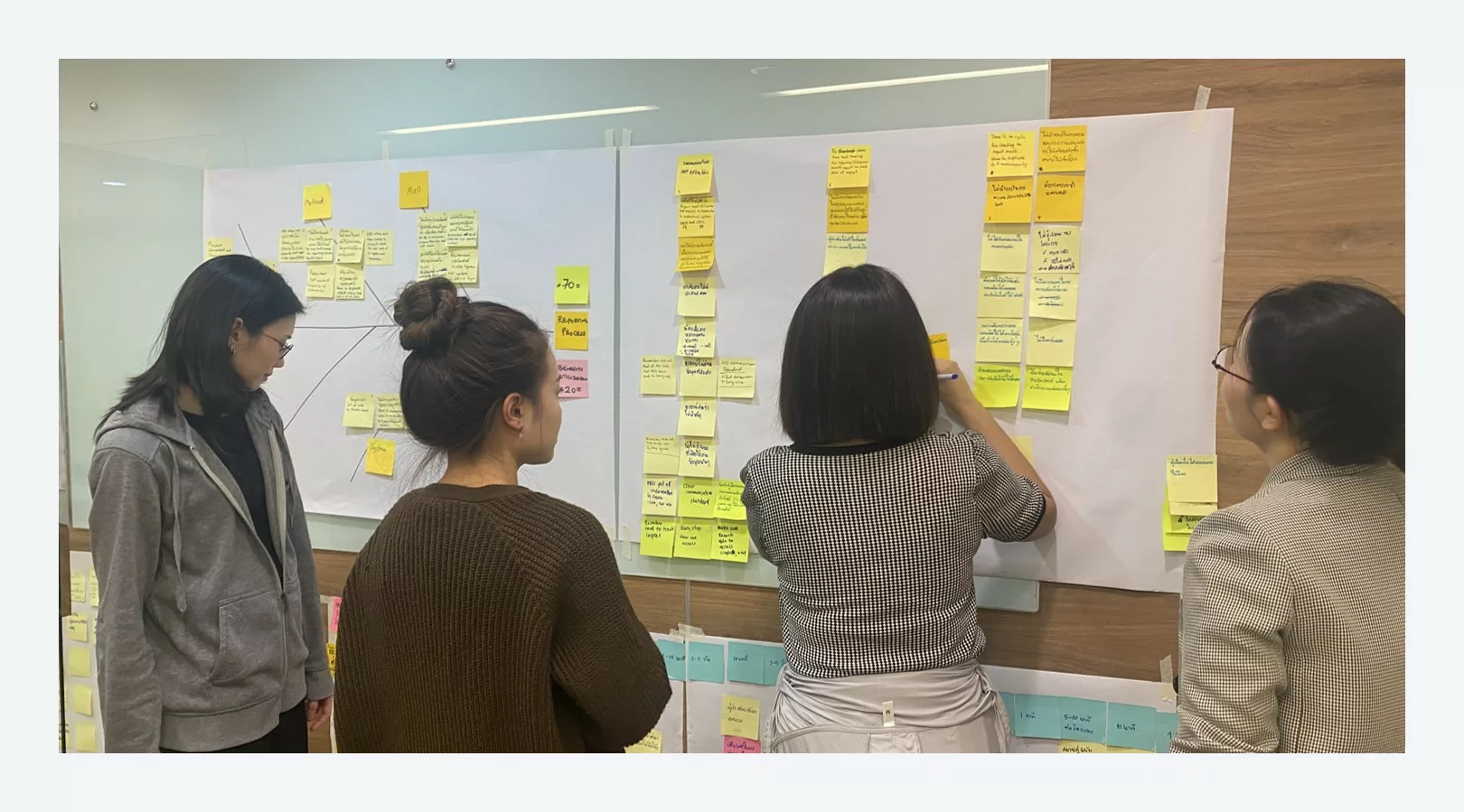
Root causes identified
- No standardized way to request projects and to plan and execute them.
- No standard approval text.
- No centralized Master Sheet.
- No defined SLA.
- Manual, repetitive data entry.
- Lack of digital workflow.
Implemented solutions
- Standard SLA for all approval steps.
- Automated approval text to eliminate errors.
- Standardized Master Sheet for all incoming projects.
- Work standardization for officers.
- Centralized data storage.
- Google form intake for researchers.
- Standard file naming and folder structure.
Results achieved
- Rework related tasks reduced from 10 to 2 per month.
- The amount of potential revenue lost due to delays, inefficiencies, and missed project opportunities was reduced from 21 million THB to 1.75 million THB.
- SLA compliance increased from 50% to 100%.
- 14M THB financial impact (Apr–Dec 2025).
- Document handling time reduced by > 80% (40 minutes to 4.5 minutes per project).
This initiative established the operational foundation for the future ONE-KRIS system.
2. Lean Project Management – improving visibility and disbursement control
KRIS previously lacked a unified project management system, which made it difficult to track project progress, manage disbursements, and ensure timely follow-up.
As a result, project status was often unclear, disbursement processes were slow, and documentation errors frequently led to rework and penalty fees for researchers.
Root causes
- Absence of a project management dashboard.
- No standardized disbursement workflow.
- Lack of standardized project categories.
- Decentralized project data.
- No tracking system for disbursement status.
Solutions implemented
- Development of a portfolio management dashboard.
- Standardized disbursement processes.
- Structured follow-up workflow.
- Centralized project data across all phases.
- Clear project status indicators within the Master Sheet.
- Training for academic service officers.
Results obtained
- Rework related tasks reduced from 20 to 3 cases per month.
- Penalty fees reduced 67%.
- 1.5M THB financial impact.
- 70% reduction in disbursement document errors.
For the first time, KRIS gained real-time visibility across all active academic service projects.
3. Data management transformation — improving accuracy and automation
KRIS’s data environment was previously fragmented, with information stored across multiple locations and lacking a standardized structure. This made reporting time-consuming and increased the risk of errors and rework.
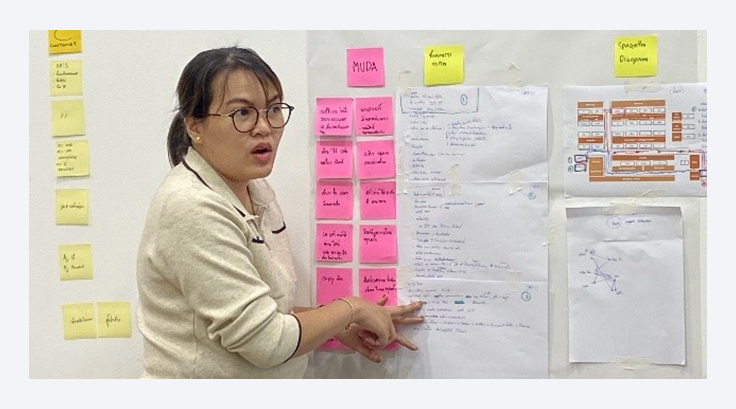
Root causes identified
- No centralized Master Sheet.
- No standard folder structure.
- Manual data entry.
- No automation between sheets.
- No Poka‑Yoke.
The solutions implemented
- Creation of standardized Master Sheets.
- Centralized data storage.
- Google Form integration with automated Master Sheet updates.
- Digital Poka Yoke mechanisms to prevent incorrect entries.
- Standard file naming and folder structures.
- Automation of monthly reporting.
Results obtained
- Data accuracy improved from 70% to 100%.
- Monthly reporting time reduced from 36 hours to 0 hours.
- Time required to locate files reduced from 10 minutes to 5 minutes.
- 564,000 THB financial impact.
This phase created the data backbone for KRIS’s future operations.
Phase 2 – Strategic Capability Building & Institutional Performance
Phase 2 focused on strengthening KRIS’s strategic capabilities: IP management, performance scoring, internal productivity, and ethics approval. These initiatives enabled KRIS to progress from operational stability to institutional excellence.
IP Protection – improving Lead Times and quality improvement
KRIS faced several challenges in managing intellectual property (IP) submissions, particularly related to long lead times, rework cycles, and limited visibility over pending requests.
Root causes identified
• Long lead times across different research submission categories.
• High rework rates.
• Lack of visibility over pending submissions.
• No standard documentation guidelines.
• No tracking of rework causes.
Solutions implemented
- Visual standards (3 posters).
- Rework reason tracking system.
- Lead time reduction initiatives.
- Improved submission quality.
Results
- Significant reduction in rework cycles.
- Improved researcher compliance with submission requirements.
- Clear visibility of the IP submission pipeline.
- Higher quality IP documentation and submissions.
This strengthened KRIS’s ability to support innovation and protect intellectual property.
Past Performance (PP) Score Improvement – maximizing research budget allocation
KRIS’s Past Performance (PP) score directly influences the allocation of research funding. Before the transformation, inaccurate data and fragmented information limited KRIS’s ability to fully utilize its funding opportunities.
Underlying causes
- Inaccurate data.
- Decentralized information management.
- Declining PP score (from 4 to 3 in 2569).
- Low utilization of funding (15%).
Solutions implemented
- Improvements to the Master Sheet system.
- Implementation of a rework tracking system.
- Increased project visibility and monitoring.
- Strengthened data accuracy and reporting practices.
Results achieved
- PP score improved from 4 to 5 (self-assessment as per criteria).
- Funding budget increased by 14%.
- Effectiveness in budget utilization increased from 15% to 95%.
This positioned KRIS as a high‑performing academic service unit.
Internal productivity – standardizing work and reducing workload
KRIS officers previously faced significant operational inefficiencies caused by fragmented reporting processes and a lack of standardized workflows.
KRIS officers faced:
- High interruption work.
- No standard follow‑up.
- Excessive time preparing monthly meetings.
- 11 different files required for reporting.
- No standard contract process.
The solutions
- Improvements to the Master Sheet structure.
- Consolidation of reporting files.
- Implementation of standardized follow-up processes.
- Improvements to contract management procedures.

The main results achieved
- Number of reporting files reduced from 11 to 4 (64% reduction).
- Significant productivity improvements across KRIS teams.
- Reduced administrative workload and stress for staff.
- Faster preparation for monthly management meetings.
KRIS achieved a leaner, more predictable workflow across its internal operations.
Ethics Approval Lead Time Reduction – Compliance Excellence
The ethics approval process was previously slow and difficult to track, creating delays for researchers and an additional administrative burden for KRIS. Ethics approval was slow and inconsistent, due to:
- Lead times around 50+ days.
- Multiple files required.
- No visibility.
- Frequent rework.
Solutions implemented
- Improvements to ethics approval standard operating procedures (SOPs).
- Redesign of the Master Sheet structure.
- Email automation saving approximately five minutes per project.
- File consolidation from three files to a single unified structure.
Results obtained
- Lead time targets established:
- Exemption: 18 days
- Full Board: 29 days
- Expedited: 23 days
- Clear visibility of ethics pipeline.
- Reduced administrative burden.
These improvements strengthened KRIS’s compliance processes and enabled faster approvals for research projects.
Together, these phases delivered over 25 MTHB in annualized financial impact and transformed KRIS into a benchmark for academic service excellence in Thailand.
Financial impact (Apr 2025 – Dec 2025)
The transformation generated more than 25 million THB in annualized financial impact, driven primarily by improvements in approval processes, project management, and data management. Key contributors included:
- Approval process transformation – 14M THB.
- Lean project management improvements – 1.5M THB.
- Data management transformation – 564,000 THB.
- Phase 2 initiatives – additional qualitative impact through improved productivity, compliance, and funding utilization.
These results demonstrate how operational improvements across multiple processes can translate into significant financial value for academic service organizations.
Cultural & organizational impact
Beyond financial results, KRIS achieved:
- A unified, standardized way of working.
- A centralized data ecosystem.
- A performance‑driven culture.
- Higher transparency and accountability.
- Reduced stress and workload for staff.
- Improved researcher satisfaction.
- Stronger institutional credibility.
The transformation also laid the foundation for ONE-KRIS, a future integrated digital system.
A benchmark for academic service operational excellence
The KRIS transformation program demonstrates how Lean principles, when applied with discipline and collaboration, can radically improve academic service operations. Through structured problem‑solving, standardization, and data‑driven management, KRIS achieved:
-
Faster approvals.
-
Zero rework environments.
-
Accurate and centralized data.
-
Reduced penalties.
-
Higher budget allocation.
-
Stronger institutional performance.
KRIS is now positioned as a benchmark for operational excellence in academic research services in Thailand.